Manawan, August 13th, 2026 – It is with profound sadness and a heavy heart that the Office of Joyce’s Principle learned of the tragic passing of young Jusi Padlayat, aged only 4 years, on August 3 in Ivujivik, Nunavik.
According to public information and family testimonies, repeated consultations and pleas for help were made over several days. Seeing the child's health deteriorate without adequate care, the family was forced to raise an alarm on social media. Tragically, despite this final effort, the unthinkable happened. This tragic situation echoes the story of Joyce Echaquan in a particularly painful way, serving as a stark reminder of how aberrant it is to have to document one's own suffering in hopes of being heard by the healthcare system.
“It is unacceptable for a child to be left to suffer for so long. Ten days of agony for a child represents a lifetime of grief and sorrow for his parents. No family should ever have to endure such an ordeal or feel that their words and concerns are being minimized. Our thoughts are with little Jusi’s loved ones during this time of immense pain,” stated Sylvestre Desterres, Interim Executive Director of the Office of Joyce’s Principle.
This tragedy serves as a brutal reminder that prompt and attentive care within the healthcare system is an absolute necessity. Respect for dignity must translate on the ground into genuine listening and concrete action across all services offered to First Nations and Inuit, a necessity that is even more critical in remote communities, where local medical resources are often the sole recourse.
It is imperative that full light be shed on the circumstances surrounding this tragedy, and that governmental authorities and the healthcare network act with the utmost rigor and diligence. The OJP offers its deepest condolences to the Padlayat family, their loved ones, and the entire community of Ivujivik as they grieve this loss.
About the Office of Joyce’s Principle
The Office of Joyce’s Principle, created following the tragic death of Ms. Joyce Echaquan in September 2020 at the Joliette Hospital, aims to ensure the adoption of Joyce’s Principle by various bodies, including the Quebec government.

⚠️ Content warning: This documentary includes scenes of medical violence and racist language toward Indigenous Peoples. It also contains footage referencing the death of Joyce Echaquan in hospital, which may be distressing to some viewers.
The Office of Joyce’s Principle highlights the participation of our ambassador Samir in The Good Canadian, where he speaks about racism in health care in Quebec and Joyce’s story.
Told through the voices of frontline workers, this documentary challenges the myth of a peaceful Canada and explores how Indigenous Peoples experience public services, past and present.
Watch the full film here: The Good Canadian
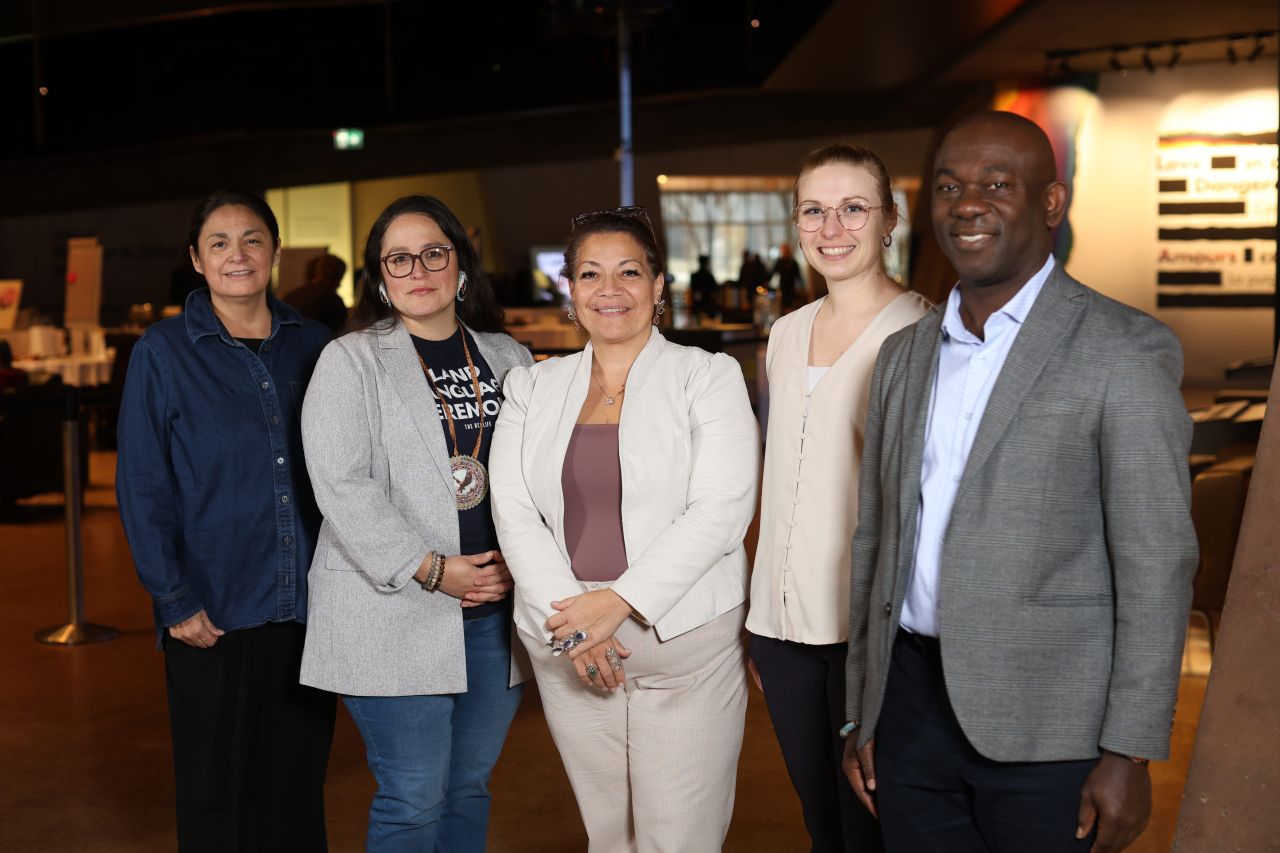
From left to right: Claudette Awashish, Internal Relations Manager (Office of Joyce’s Principle), Jennifer Petiquay-Dufresne, Executive Director (Office of Joyce’s Principle), Karennahá:wi McComber, Director, Indigenous Health, CIHI, Joseph Emmanuel Amuah, Manager, Indigenous Health, CIHI, Karine Brousseau, Senior Analyst, Indigenous Health, CIHI.
The Office of Joyce’s Principle is pleased to announce the signing of a collaboration agreement with the Canadian Institute for Health Information (CIHI). This formal agreement marks a new step in building relationships grounded in respect, reciprocity and the recognition of the rights of Indigenous Peoples within health systems.
This collaboration with CIHI strengthens this work by aligning the efforts of each organization around a shared vision of transforming health systems.
As part of this agreement, the Office of Joyce’s Principle and CIHI commit to supporting one another in their respective missions: advancing cultural safety for First Nations, Inuit and Metis within Canadian health systems, and developing measurement tools to improve equity and accessibility in care.
By working together, our organizations aim to help build health systems that are safer, more accessible and more respectful, where no Indigenous person will ever again feel deprived of care or dignity because of who they are.
To learn more about the collaboration agreement and CIHI’s work on measuring cultural safety in health systems, read the news release on CIHI’s website: CIHI and the Office of Joyce’s Principle to work together for safer health care for First Nations, Inuit and Métis.
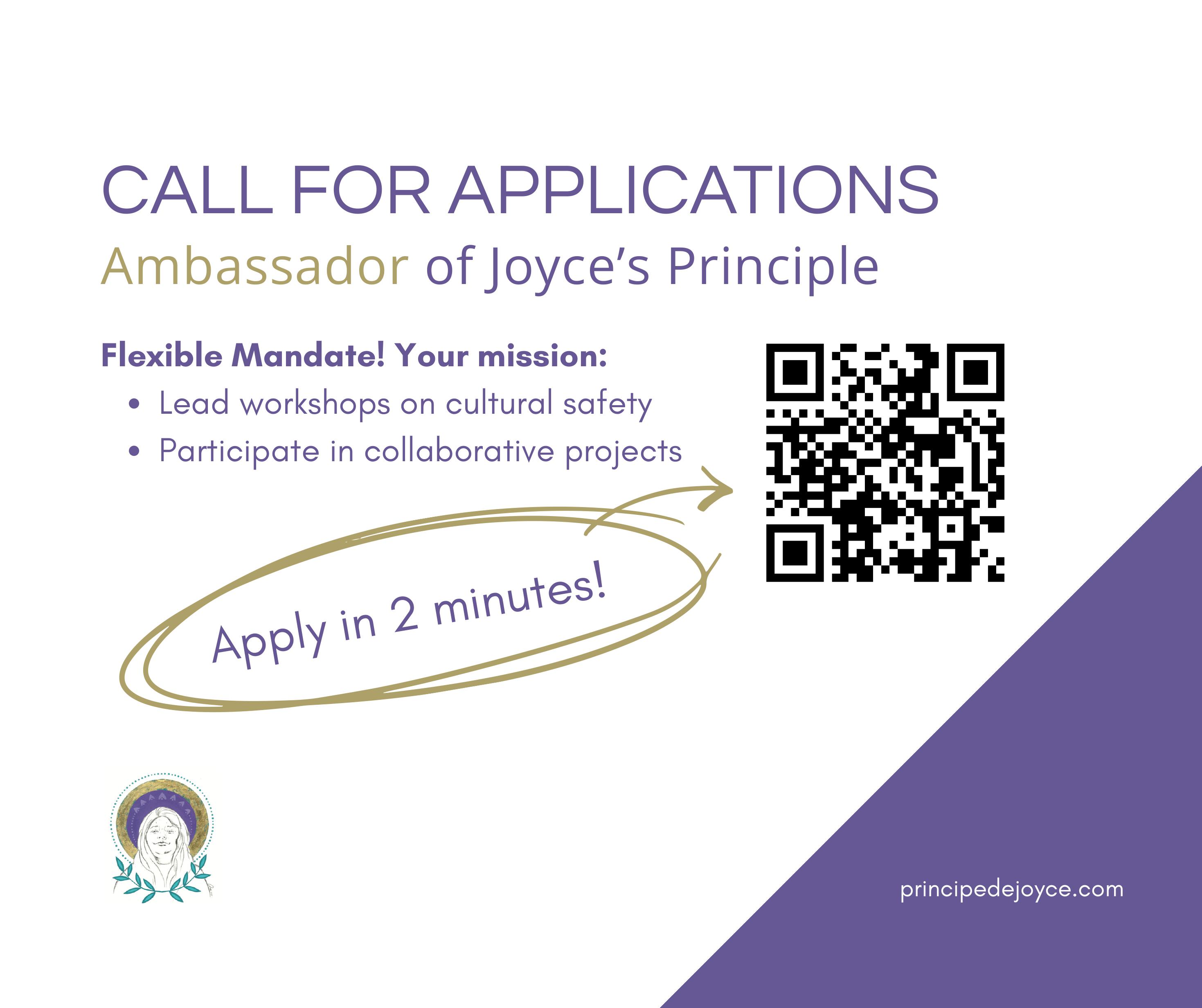
Retired and semi-retired persons are welcome!
Your lived experience, field knowledge, and holistic perspective of the health and social service systems are valuable assets for advancing cultural safety and transforming practices. Since the services required may vary depending on several factors, the Office of Joyce’s Principle encourages individuals at different stages of their professional journeys to submit their services.
The Office of Joyce’s Principle strongly encourages service proposals from members of First Peoples. Experience and community-based cultural knowledge will be considered an asset.
| ATIKAMEKW COUNCIL OF MANAWAN | |||
| TITLE : | Ambassador for Joyce’s Principle | ||
| POSTING PERIOD : | Ends on February 13, 2026 | ||
| NETWORK CONTACT PERSON : | External Relations Officer | ||
| CONTRACT DETAILS: | Professional contract (non-salaried) | ||
| Remote work with occasional travel | |||
| Approximately 5 to 10 hours per month (flexible schedule depending on assignments) | |||
| Compensation in accordance with the Office of Joyce’s Principle’s Ambassadors Compensation Policy | |||
| CONTEXT : | Joyce’s Principle aims to guarantee all Indigenous people the right to receive health and social services free of discrimination, with respect for their identity, culture, and knowledge systems. | ||
| Through its Ambassadors Network, the Office of Joyce’s Principle mobilizes professionals from diverse backgrounds to advance cultural safety within institutions and communities. | |||
| CONTRACT DESCRIPTION : | The Ambassador acts as a resource person, facilitator, and advocate of Joyce’s Principle, contributing to its dissemination and integration in health and social service environments. | ||
| Expected or required services : | |||
|
|||
|
|||
|
|||
|
|||
| DESIRED PROFILE : |
|
||
|
|||
|
|||
|
|||
|
|||
|
|||
|
|||
|
|||
|
|||
To submit your service proposal (letter of interest, references, proposal, curriculum vitae, etc.), click hereTo obtain more information, write to: : info@bpjoyce.ca |
On December 11, 2025, a First Nations man in a situation of significant vulnerability presented himself at the Victoria hospital, Prince Albert, in Saskatchewan, seeking care. Instead of receiving the medical attention to which every person is entitled, he was subjected to an unacceptable act of violence: forcibly removed by security guards without regard for his health condition, dragged outside, and left in the snow despite extreme freezing temperatures. These actions were strongly denounced by several organizations, including the Federation of Sovereign Indigenous Nations (FSIN) and the Prince Albert Grand Council.
The Office of Joyce's Principle Bureau expresses its profound outrage and deep sorrow in response to this tragic event. Once again, this incident exposes the persistent and deeply rooted systemic racism within Canada’s health care systems. While shocking, it is sadly not surprising: Indigenous people continue to face prejudice, dehumanizing treatment, and implicit or explicit denial of access to safe, respectful, and culturally appropriate care.
The Office firmly condemns these practices and expresses its full solidarity with the victim, his family, the Indigenous communities of the region, as well as the leaders and organizations demanding accountability. In keeping with its mission, the Office remains vigilant in the face of such systemic violence, stands ready to support affected parties, and continues its work toward meaningful transformation of health care systems—grounded in equity, cultural safety, and respect for the fundamental rights of Indigenous Peoples.
For more details on the incident: https://ici.radio-canada.ca/nouvelle/2214692/homme-renvoye-hopital-prince-albert.
The Office of Joyce’s Principle
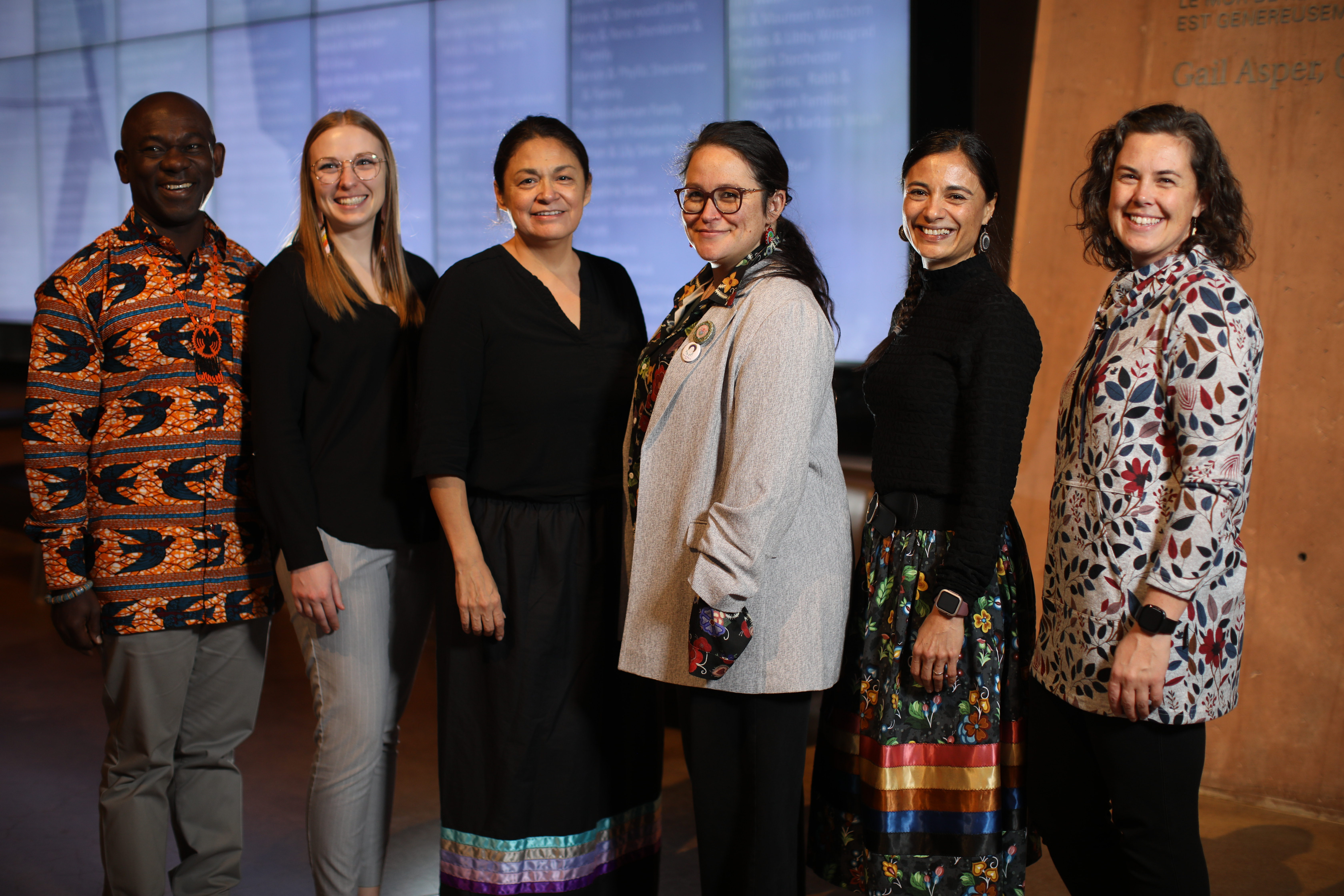
The Office of Joyce’s Principle was invited to participate in the Cultural Safety Gathering organized by Healthcare Excellence Canada on November 26 and 27, 2025 in Winnipeg. This national event brought together Indigenous health experts from across Canada, including the Indigenous Health team from the Canadian Institute for Health Information (CIHI).
The gathering aimed to strengthen relationships among First Nations, Inuit and Métis leaders addressing systemic racism in health systems. It also advanced work to create a cultural safety pathway to support healthcare organizations in their journeys to address racism experienced by First Nations, Inuit and Métis and improve cultural safety.
We further had the opportunity to review and provide feedback on a national set of Cultural Safety and Indigenous-Specific Racism indicators being developed by CIHI. These indicators will be integrated into the cultural safety pathway to contribute in advancing cultural safety in the health system.
The Office of Joyce’s Principle highlighted Atikamekw expertise in this effort, while acknowledging the innovations of First Nations, Inuit and Métis experts in provinces committed to addressing systemic racism. The Office reaffirms its commitment to ongoing partnerships with these new allies to ensure effective respect for Indigenous Peoples' right to cultural safety in Quebec and in Canada.
The Office of Joyce's Principle
The Office of the Joyce Principle affirms its solidarity with our colleague, Professor Karine Millaire – who is currently drafting the Guide of Rights on the Joyce Principle and Cultural Safety – in her efforts with international bodies and her participation in the video capsule by the Observatoire pour la justice migrante (OPLJM), which analyzes the risks that Bill No. 1 (PL1) poses to the rule of law and fundamental rights.
The Office formally expresses its opposition to Bill No. 1 (PL1), which proposes to adopt a Constitution for Quebec without prior, free, and informed consultations with Indigenous peoples. This unilateral approach contradicts the fundamental principle of cultural safety, defined as the right of Indigenous persons and First Nations to be respected in their distinct identity, language, culture, and worldview, free from systemic discrimination.
Cultural safety, at the heart of the Joyce Principle, requires public institutions to actively dismantle structural barriers rooted in colonialism. However, PL1 imposes a rigid integration policy based on indivisible “national values,” perpetuating a colonial approach thatinstitutionalizes structural discrimination, denies the self‑determination of Indigenous nations, and enforces cultural assimilation contrary to Article 24 of the United Nations Declaration on the Rights of Indigenous Peoples (UNDRIP).
This orientation directly opposes the Joyce Principle, which calls for the proactive elimination of systemic barriers to ensure dignified, holistic, and culturally safe care—recognizing that Indigenous health cannot be separated from cultural integrity.
The Office invites to the National Assembly of Quebec to immediately withdraw Bill No. 1, due to its fundamental incompatibility with Indigenous rights and cultural safety. At the same time, we call for the formal adoption of the Joyce Principle in all future reforms, in order touphold ancestral and treaty rights and ensure culturally safe environments aligned with international standards.
For further information or collaboration: info@bpjoyce.ca.
The Office of Joyce's Principle

On November 24, the Office of Joyce’s Principle met with the leaders of the Assembly of First Nations Quebec-Labrador (AFNQL) in Montreal to present its mission and current initiatives. Jennifer Petiquay-Dufresne - Executive Director, Julia Dubé - External Relations Officer and Claudette Awashish - Community Relations Officer, represented the Office at this meeting, which was marked by constructive discussions on promoting Joyce’s Principle and future collaborations.
Chief Sipi Flamand of Manawan and Jennifer Petiquay-Dufresne presented the strategic plan and the achievements of the Office of Joyce’s Principle to the AFNQL Chiefs. The work of the Office was highlighted by AFNQL Regional Chief Francis Verreault-Paul and several other leaders in attendance.
The Chiefs gathered expressed the need for First Nations to systematically document cases of systemic racism in Quebec’s health institutions, since this is not currently done by the province. They emphasized that racist incidents in hospitals continue to occur without being properly acknowledged, due in part to the refusal to recognize systemic racism.
The presentation of the Office’s milestones and long-term vision was very well received by the Chiefs, and the Office extends its sincere gratitude for the invitation to this important meeting. The Office remains committed to responding to on-the-ground realities while upholding Indigenous self-determination and the distinct protocols of each Nation.
‘This meeting demonstrates our shared commitment to making Joyce’s Principle a concrete lever for transforming health and social services systems for and with First Nations,’ said Jennifer Petiquay-Dufresne.
The Office of Joyce's Principle
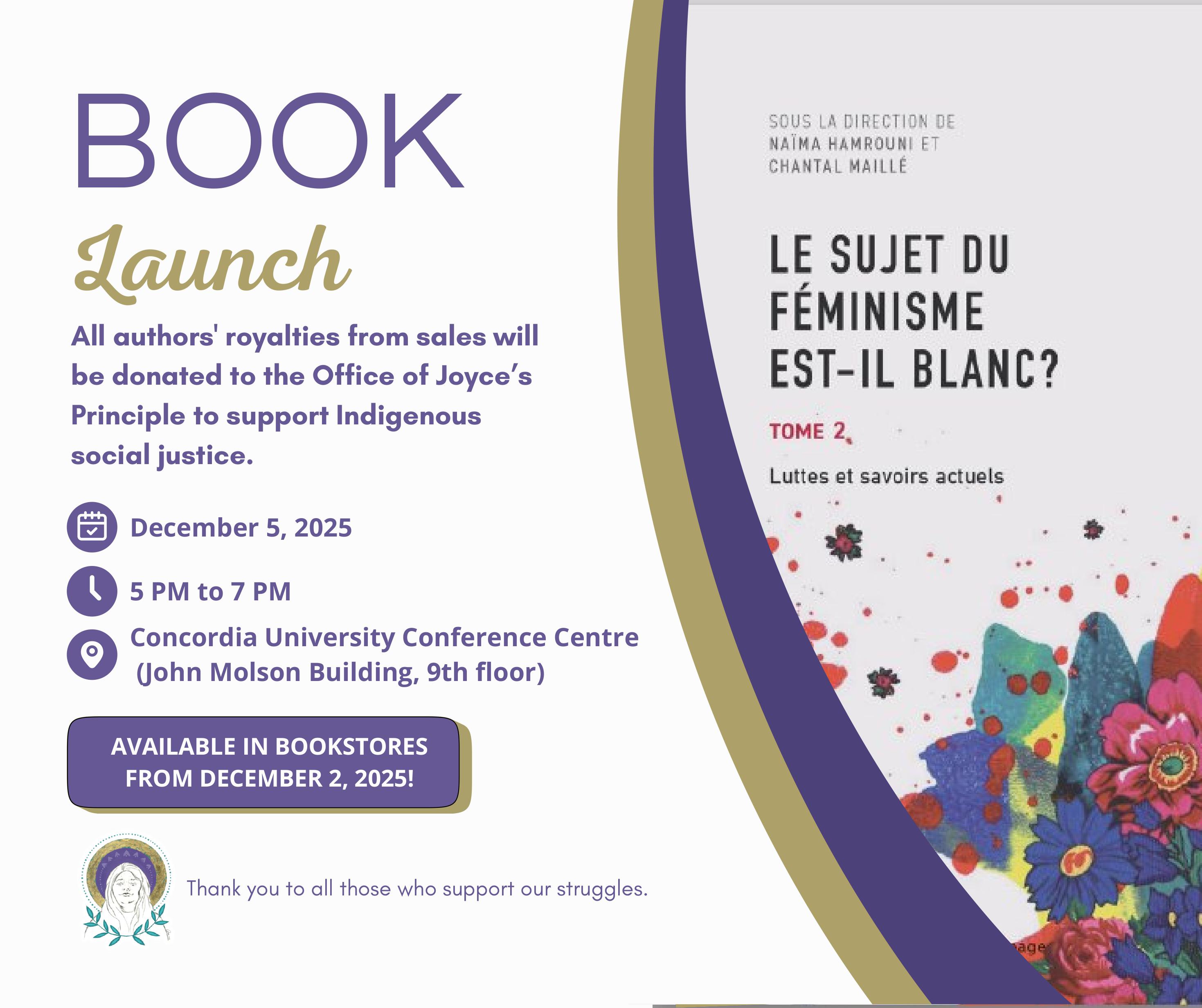
It is with a great pleasure that the Office of Joyce’ Principle announces the release of the book Is the Subject of Feminism White? Volume 2 – Current Struggles and Knowledge, edited by Naïma Hamrouni and Chantal Maillé, published by Éditions du Remue-Ménage.
Our Executive Director Jennifer Petiquay-Dufresne is among the authors published in this collective work, with a chapter on Joyce’s Principle as a feminist struggle tool.
Join us on December 5 for the RéQEF annual colloquium Decentering White Feminism: Current Struggles and Issues and the official book launch, from 5pm to 7pm at Concordia University's Conference Centre (JMSB, 9th floor).
Why This Book?
This collective work gives voice to about twenty authors, including Alia Al-Saji, Leila Benhadjoudja, Marlihan Lopez, and many others, with cover art by Eruoma Awashish. It explores contemporary feminist struggles and marginalized knowledge.
A sincere thank you to all the authors and @Éditions du Remue-Ménage. All authors' royalties from sales will be donated to the Office of Joyce’s Principle to support Indigenous social justice and First Nations self-determination. This gesture directly contributes to equity, rights defense, and the well-being of Indigenous peoples.
Available in bookstores from December 2, 2025!
For more information, visit the website of the Réseau québécois en études féministes: Colloque annuel du RéQEF « Décentrer le féminisme blanc : luttes et enjeux actuels
About the book: Le sujet du féminisme est-il blanc ? Tome II
The Office of Joyce's Principle
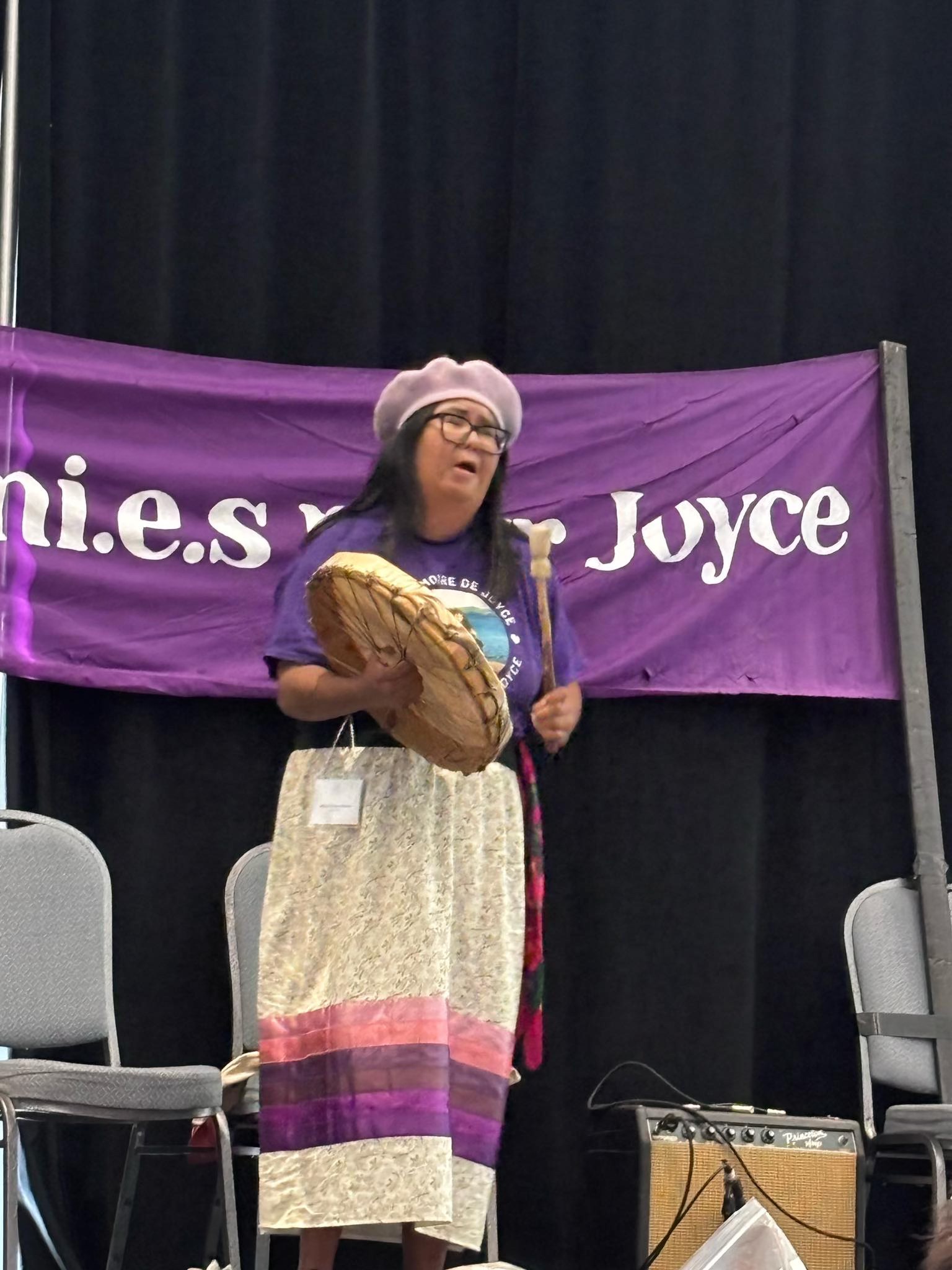
It is with deep sadness that the Office of Joyce’s Principle learned of the sudden passing of Mikon Ottawa-Niquay. The Office of Joyce’s Principle extends its sincerest condolences to her family, her loved ones, and to all those who had the privilege of knowing her.
Present at the “Joyce, Five Years Later” event, Mikon offered a powerful performance that profoundly moved everyone gathered. Her commitment and sensitivity helped keep Joyce’s memory very much alive.
Today, the Office of Joyce’s Principle wishes to pay tribute to her and to warmly thank her for her dedication to the memory of Joyce and for her engagement with the community. Her passing leaves a great void, and our thoughts are with all those who are grieving this loss.
The Office of Joyce's Principle
On October 22, 2015, the report “Abus de la SQ: des femmes brisent le silence” broadcast on Ici Radio-Canada's program Enquête revealed the courageous testimonies of Indigenous women from Val-d’Or denouncing violence and abuse perpetrated by certain members of the police forces. This pivotal moment highlighted the realities of systemic racism and systemic discrimination deeply rooted in the relationships between Indigenous populations and public services in Quebec.
Ten years later, the Office of Joyce’s Principle recognizes the importance of the courage that has opened a fundamental dialogue. The final report of the Public Inquiry Commission on Relations Between Indigenous Peoples and Certain Public Services (Viens Commission), released in 2019, explicitly acknowledges the existence of systemic discrimination against First Nations and Inuit, with 142 calls to action for profound institutional transformation.
Despite efforts, notably in the health sector with measures for cultural safety, the most recent report from the Ombudsman (2025) reveals that the implementation of these recommendations remains incomplete, fragmented, and often minimal. Translating recommendations into sustainable, coordinated, and systemic actions remains a major challenge.
The Ombudsman stresses that success depends on five key principles: a strong global strategy and coordinated leadership, coherence between commitments and actions, deep systemic change, collaboration and co-construction with Indigenous representatives, and a thorough reading of calls to action to understand their purpose.
Furthermore, initiatives such as the Iskweu Project, led by the Native Women’s Shelter of Montreal, demonstrate that successes are significantly greater when actions are led by Indigenous peoples themselves. This project provides concrete support to the families of missing andmurdered Indigenous women, girls, transgender, and two-spirit persons, offering culturally appropriate accompaniment and rigorous follow-up of investigations. This approach shows how Indigenous-led management improves the effectiveness and quality of support provided.
On this tenth anniversary, the Office of Joyce’s Principle pays tribute to the determination, courage, and resilience of the women of Val-d’Or. It reaffirms its commitment to continuing its efforts for awareness and action to make Quebec an inclusive environment, respectful of the rights and dignity of all people, especially Indigenous communities.
The Office of Joyce’s Principle
The Office of Joyce’s Principle extends its deepest condolences and heartfelt solidarity to the family of Ms. Shandi Cook, a young Cree mother from the Sapotaweyak Nation. Her death, following events at the Swan River hospital in Manitoba, has caused deep sorrow and raised many questions within her community. Our thoughts are with her loved ones during this painful time.
On October 11, Ms. Cook went to the Swan Valley Health Centre experiencing severe breathing difficulties and coughing up blood. Despite the apparent seriousness of her condition, she was discharged without receiving appropriate care. She was found deceased in her sleep the following morning at home.
Like Joyce Echaquan, Ms. Shandi Cook had the right to be heard, cared for, and treated with dignity—free from prejudice and discrimination. She had the right to compassionate and humane care. This tragic loss reminds us how essential these rights remain, at the very heart of Joyce’s Principle, and how they require our constant vigilance.
This event, which is currently under review by the relevant authorities, highlights the ongoing need to pursue collective efforts to eliminate systemic inequalities within the healthcare network. It raises broader questions about trust in the healthcare system, equity in access to care, quality of treatment, and the removal of institutional barriers that still too often hinder Indigenous Peoples.
It is the responsibility of governments and health authorities to ensure care that is grounded in respect, cultural competence, and full recognition of fundamental rights. The Office of Joyce’s Principle emphasizes the importance of firmly embedding cultural safety and respect for Indigenous rights within healthcare practices, training, and governance structures.
The Office of Joyce’s Principle reaffirms its commitment to working closely with governments, Indigenous organizations, and healthcare institutions to build a system that is truly equitable, compassionate, and respectful.
Never again should an Indigenous person die deprived of care or respect because of their identity.
The Office of Joyce's Principle
Showing my support.
Share this page.


Illustration: Work of Eruoma Awashish, artist Atikamekw Nehirowiskwew of Opitciwan
Title: Justice for Joyce 2020
In memory of Joyce Echaquan 1983-2020